Complex pipeline support
Coordinate sensors, receivers, ISPs and processing blocks as one camera, including pipelines that expose multiple simultaneous streams.

The open source camera stack
libcamera brings modern camera support to Linux.
It gives your product team control of complex imaging hardware without being tied to a closed, vendor-specific camera stack.
Created and maintained by Ideas on Board
Our engineers work across the whole Linux imaging stack, from kernel drivers and media pipelines to image processing algorithms and application APIs. When a problem crosses those boundaries, we know where to solve it.
Why we created libcamera
Camera hardware changed. The software model had to change with it.
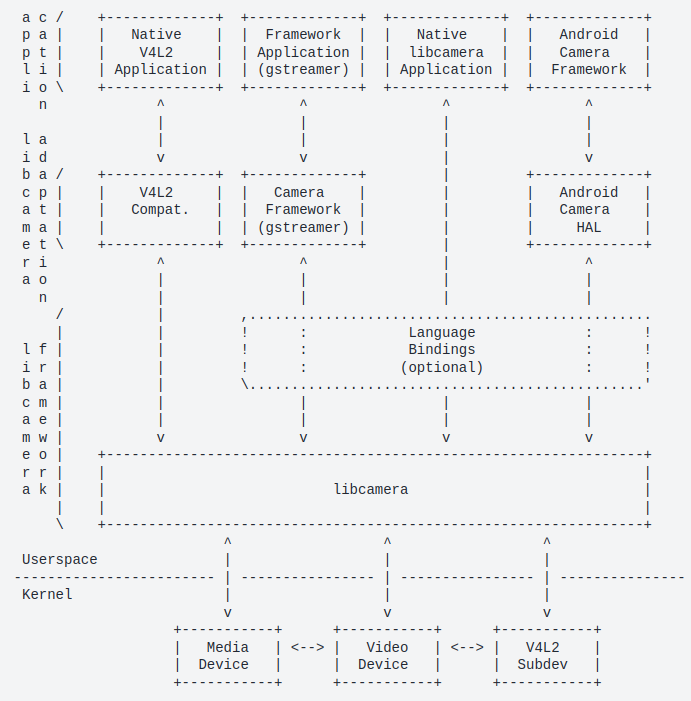
A modern embedded camera is not a single device producing ready-made frames. RAW sensors, CSI-2 receivers, image signal processors, statistics engines and tuning algorithms must all operate together, often producing several streams at once.
The traditional Linux camera API could expose the individual pieces, but it could not coordinate the complete pipeline. Vendors filled that gap with private stacks that were difficult to maintain, port and integrate upstream.
We created libcamera to provide the missing layer: an open framework that understands the pipeline, controls it frame by frame, and presents stable interfaces to applications.
What libcamera gives your product
A camera stack you can build on, inspect and control.
Coordinate sensors, receivers, ISPs and processing blocks as one camera, including pipelines that expose multiple simultaneous streams.
Run and tune auto-exposure, auto-focus, white balance and other image processing algorithms for your sensor, optics and product requirements.
Connect cameras to native applications, GStreamer, PipeWire, Android and other frameworks through well-defined APIs.
Keep the application-facing model consistent while supporting different sensors, ISPs and system-on-chip camera pipelines.
Process RAW images on the CPU or GPU where a suitable hardware ISP is unavailable, or where your product needs a custom processing path.
Build on a community-developed project rather than carrying a private camera stack that becomes harder to update with every product release.
How we help
Expertise from first architecture decisions to production support.
Camera failures rarely stay inside one software component. Our team can own the complete problem or work alongside your engineers at the layer where you need us most.
Select sensors and processing hardware, map the media pipeline, and make architectural decisions that support your image quality, latency, power and maintenance goals.
Develop and upstream kernel drivers, add a libcamera pipeline handler, integrate image processing algorithms, and bring the first reliable frames through your complete system.
Tune the camera for your optics and use case, validate behaviour under real lighting conditions, and improve image quality without hiding the process in a proprietary tuning workflow.
Connect the camera to your application stack, resolve performance and reliability issues, train your engineers, and keep support aligned with upstream development.
Proven across the ecosystem
From embedded boards to shipping platforms
Our libcamera work spans Intel, Rockchip, Raspberry Pi, NXP, Amlogic, Renesas and Qualcomm platforms, with sensors from the major imaging vendors. We also develop software ISP paths for systems that need a fully open or custom processing solution.




Your product, supported by the team behind libcamera
Bring us the difficult camera problem.
Whether you are selecting hardware, bringing up a new ISP, fixing image quality, or preparing an existing camera stack for production, we can help you find the shortest maintainable route forward.